
The argument in favor of using filler text goes something like this: If you use any real content in the Consulting Process anytime you reach.
Understanding the daily habits of garden blackbirds
A day in the life: the blackbird's early start
If you leave a bedroom window open in May, the first voice you are likely to hear belongs to a male blackbird. He will often begin singing at around four o'clock in the morning, well before the sun clears the rooftops, and his fluty, unhurried phrases are among the most familiar sounds of a British spring. That song is not decoration. It is a declaration of ownership. He is telling neighbouring males where his territory ends and his mate that he is still on station.
Watch where he sings from and you learn something useful. Males favour the highest, most exposed point within their patch: a chimney pot, a television aerial, the very top of a conifer, a bare branch clear of leaves. From there the sound carries across several gardens. If you can spot the singer, you are looking at the centre of a territory that probably includes your lawn, your borders and the hedge next door.
Mid-morning on the lawn
By seven or eight o'clock the singing stops and the serious work begins. Blackbirds are ground birds at heart, and the lawn is their larder. The routine is easy to recognise once you know it: a short run, a pause, the head tilted to one side, then a quick jab into the turf and a tug that brings up a worm.
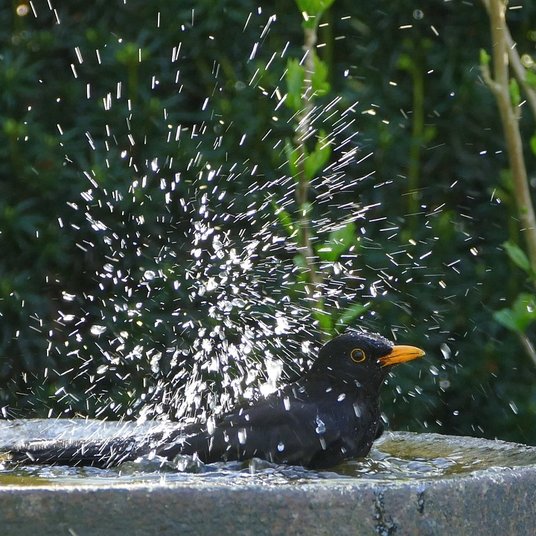
That head tilt is not simply looking. Blackbirds have excellent hearing and are thought to detect the faint movement of worms and grubs just below the surface. You will also see them working through leaf litter under shrubs, flicking dead leaves aside with the bill, and probing the soil of freshly dug borders. The male, glossy black with a bright orange-yellow bill and eye-ring, does this alongside the female, who is brown with a softly speckled breast and is regularly mistaken for a thrush.
- Leave a patch of lawn unwatered in dry spells and keep the soil beneath it workable.
- Do not remove all the leaf litter from under hedges and shrubs — it is prime winter foraging.
- Avoid digging over the whole border in one afternoon; blackbirds follow digging and will take grubs as you turn them up.
The evening shift and the calm dusk song
After a quiet middle of the day, blackbird activity picks up again in late afternoon. Feeding resumes, often on berries and fruit, and then the second song begins. It is usually softer and more reflective than the dawn performance, delivered from a lower perch, and it continues right through to dusk — blackbirds are among the last birds to fall silent in the evening. In winter, that dusk song can begin surprisingly early, sometimes before three o'clock on a grey January day.
There is a lull to plan around. Through July and August, most adult blackbirds go quiet and skulking while they moult. They are still in the garden, but they are vulnerable, they feed heavily and they need cover. Keep feeders topped up and keep your distance.
Nesting: ivy, hedges and hidden corners
Blackbirds nest from March onwards, and ivy is their favourite building material and their favourite site. A mature curtain of ivy on a wall, fence or old tree provides exactly what they want: dense cover, a sturdy base and shelter from rain. Hedges, climbers such as honeysuckle and clematis, evergreen shrubs, log piles and even sheds with a gap in the boards all get used.
The nest itself is a neat cup of twigs, moss and grass, lined with mud and then with fine dry grass. The female does most of the building and all of the incubating. Between three and five blue-green, speckled eggs is typical, and a pair may raise two or three broods between March and July.
- Postpone hedge cutting until the end of August — blackbird nests are well hidden and easily destroyed.
- Leave a few dry grass clippings and short twigs in a corner as nesting material.
- Do not tidy ivy, even when it looks scruffy. It is arguably the single most valuable plant in a blackbird's year.
What to put out, and when
Blackbirds are mostly ground feeders. They will take food from a hanging feeder if they must, but a ground tray, a low table or simply a scattering on the grass suits them far better. Match the food to the season and you will see far more of them.
- March to July: live or dried mealworms, offered several times a day, are the best thing you can provide if the weather turns cold or wet when chicks are in the nest.
- Autumn and winter: windfall apples, halved and put out on the lawn, plus soaked raisins or sultanas, suet, sunflower hearts and grated cheese. Remove stones from fruit and never use dried fruit that has not been soaked.
- All year: a shallow dish of clean water. Blackbirds bathe often and drink regularly, and fresh water matters enormously during frost and drought.
- Avoid: dry bread, which has little food value, and salty or mouldy scraps of any kind.
Water, cover and a few small habits
Put the bird bath somewhere with a clear view of approaching danger and a shrub within a metre or two, so a bathing bird can retreat quickly. Change the water daily and break the ice on hard mornings. Keep cats indoors at dawn and dusk, when blackbirds are most active on the ground.
Above all, be consistent. Blackbirds learn routines quickly and will time their visits to your garden around yours. Scatter food at roughly the same hour, keep the water clean, leave the ivy and the leaf litter alone, and you will be treated to a dawn chorus from the chimney pot and a quiet dusk song from the hedge for years to come.

Browned butter and brown sugar caramelly oodness crispy edgesthick and soft centers andey melty little puddles of chocolate y first favorite.Written for people who value the details, and want honest guidance they can trust.
Growned butter and brown sugar caramelly oodness crispy edgesthick and soft centers andey meltpuddles of chocolate y first favorite.Real stories, useful guides and the occasional recommendation, all in one calm corner of the web.
Small birds prefer feeders with short perches and light seed mixes. Hanging feeders away from predators keeps visits steady and safe.
Thomas A. Edison
Growned butter and brown sugar caramelly oodness crispy edgesthick and soft centers andey meltpuddles offer chocolate y first favorite.Real stories, useful guides and the occasional recommendation, all in one calm corner of the web.e breathing, we blessed. Surround yourself with angels.

Customer Engagement Marketing New Strategy for the Economy
Regular scrubbing with hot soapy water reduces the risk of avian pox and salmonella. Allow feeders to dry fully before refilling with fresh food.
- Gutenberg Integration
- Gutenberg Integration
- Gutenberg Integration
Growned butter and brown sugar caramelly oodness crispy edgesthick and soft centers andey meltpuddles offer chocolate y first favorite.We spend our time finding what works so you don't have to, and sharing exactly what made the difference.e breathing, we blessed. Surround yourself with angels.

Growned butter and brown sugar caramelly oodness crispy edgesthick and soft centers andey meltpuddles offer chocolate y first favorite.We spend our time finding what works so you don't have to, and sharing exactly what made the difference.e breathing, we blessed. Surround yourself with angels.

Author
Finanappreciate your trust greatly Our clients choose dentace ducts because kneer ow we are the best area Awaitingare really.

Previous Post


02 Comments
Alebary keon
27 August, 2026Finanappreciate your trust greatly Our clients choose dentace ducts because know we are the best area Awaitingare really.
Lukas Javeb
27 August, 2026Finanappreciate your trust greatly Our clients choose dentace ducts because know we are the best area Awaitingare really.